


Last Updated: November 2, 2026
Quick Summary
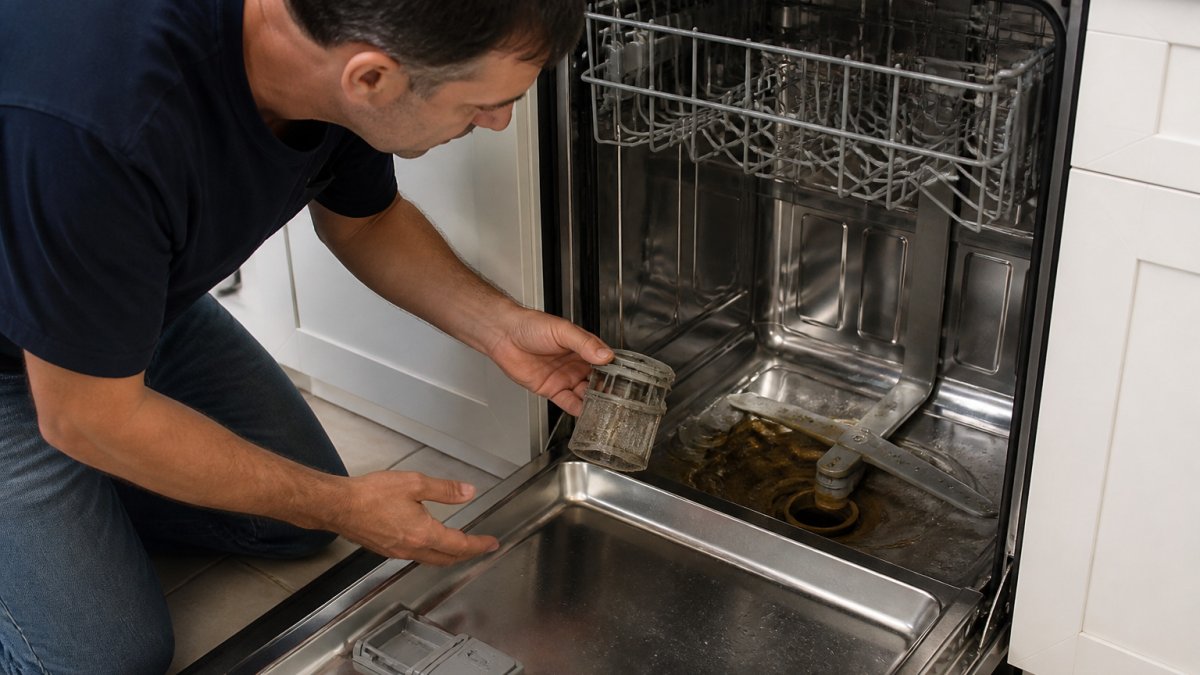
A dishwasher that won't drain usually has a blockage, most often a clogged filter, a kinked drain hose, or a clogged air gap on the countertop. Turn off power first, then check these simple parts in order before assuming the pump has failed. Cleaning the dishwasher drain path is often all it takes to restore normal draining.
- Turn off power at the breaker or unplug the dishwasher before opening anything.
- Clean the filter at the bottom of the tub, since it is the most common cause of drain trouble.
- Straighten kinks in the drain hose and clear any debris from inside it.
- Remove and clean the air gap cylinder on the countertop, which clogs easily with food particles.
- Check the drain pump impeller for trapped debris, and replace the pump if it will not turn freely.
Table of Contents
- Before You Start: Safety Steps and Tools You Need
- How to Clean a Dishwasher Filter
- Checking for a Dishwasher Drain Hose Clogged With Debris
- Clearing a Dishwasher Air Gap Clogged With Food Particles
- Dishwasher Drain Pump Troubleshooting and Error Code Checks
- Preventive Maintenance Schedule and When to Call a Technician
- Frequently Asked Questions
A dishwasher that won't drain is one of the most common appliance problems homeowners face. Standing water at the bottom of the tub usually points to a blockage, and most of the time the fix is simpler than it looks.
Most drain problems come from one of a few places. A dishwasher drains by pumping dirty water out through a hose that runs to your sink or garbage disposal. When any part of that path gets blocked, the water has nowhere to go.
The most frequent causes include:
- A clogged filter at the bottom of the tub
- A kinked or blocked drain hose
- A jammed garbage disposal knock-out plug or connection
- A clogged air gap on the countertop
- A failing drain pump or a jammed impeller
- A clogged sink drain or drain line
A common mistake is assuming the dishwasher itself is broken. In many cases, the problem sits in the sink or the plumbing connected to it. Start with the simple checks before you assume a major part has failed.
Before You Start: Safety Steps and Tools You Need
Before you open anything, turn off power to the dishwasher at the breaker or unplug it. Water and electricity do not mix, so this step matters.
Shut off the water supply under the sink if you plan to disconnect any hoses. Keep a towel and a shallow pan nearby to catch leftover water.
You will need:
- A flashlight
- Towels or a small bucket
- Pliers and a screwdriver
- Safety goggles
- A plumbing snake or drain auger for stubborn clogs
Wear gloves when you reach into the tub, since food residue can carry bacteria.
How to Clean a Dishwasher Filter
The filter is the first place to check, and it is the most common source of drain trouble. Food particles collect here and block the water path.
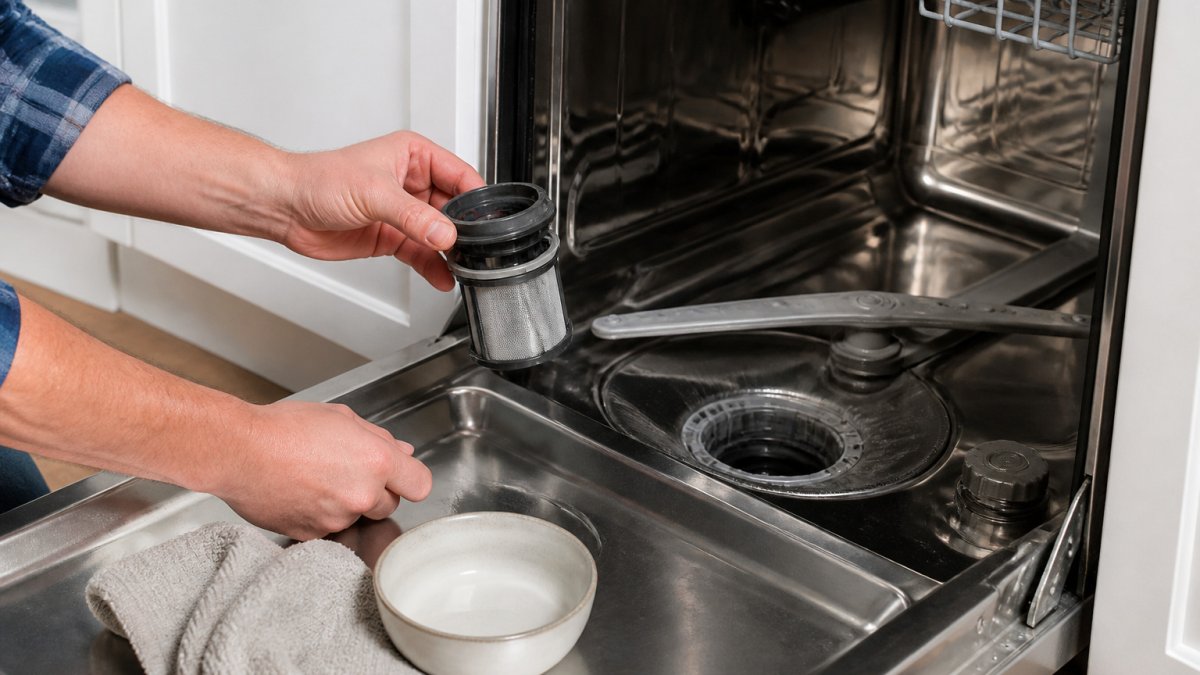
- Remove the lower dish rack to access the filter area.
- Twist the filter cover counterclockwise and lift out the filter assembly.
- Rinse the filter under warm running water, using a soft brush to loosen stuck debris.
- Check the sump area under the filter for leftover food or broken glass. Remove anything you find.
- Reinstall the filter and turn it clockwise until it locks.
Clean the filter at least once a month. Heavy users may need to clean it every two weeks.
Checking for a Dishwasher Drain Hose Clogged With Debris
If the filter is clean and the water still won't drain, check the drain hose. This hose carries water from the dishwasher to the sink drain or garbage disposal.
Pull the dishwasher out slightly so you can reach the back. Look for kinks or sharp bends in the hose. Straighten any kinks you find.
Next, disconnect the hose at the clamp and check inside for blockage. Run water through it or use a flexible brush to clear debris. Reattach the hose and secure the clamp firmly so it does not leak.
Watch out: Do not force a hose that feels stuck. Forcing it can crack the connection and cause leaks under the sink.
Clearing a Dishwasher Air Gap Clogged With Food Particles
Many homes have a small cylinder mounted on the countertop next to the sink. This is the air gap. It stops dirty water from flowing back into the dishwasher, and it clogs easily.
Remove the decorative cap on top of the air gap. Pull out the cylinder and clean out any food particles or grease. Use a thin brush or a pipe cleaner to clear the inner tubes.
Once it is clean, reinstall the cylinder and cap. Run a short cycle to test whether water now drains properly.
A clogged air gap often causes water to back up and gurgle. If your sink also drains slowly, the blockage may be shared, so check the sink drain too.
Dishwasher Drain Pump Troubleshooting and Error Code Checks
If the filter, hose, and air gap are clear and water still sits in the tub, the drain pump is the next suspect. The pump pushes water out of the tub, and it fails in one of two ways: the impeller jams on debris, or the pump motor or control board stops sending power to it. Persistent blockages often stem from internal buildup that requires you to clear grease from drains before assuming the motor has reached the end of its functional life.
Check the impeller first
The impeller is the small rotating blade inside the pump. Most pumps sit under the sump at the bottom of the tub, behind a removable cover or a twist-lock strainer housing.
- Turn off power at the breaker and remove standing water with a towel or shop vac.
- Remove the lower rack and the filter assembly to expose the sump.
- Take off the pump cover, most twist counterclockwise, but some are held by Torx screws.
- Shine a flashlight into the impeller cavity and pull out trapped debris: bones, glass shards, toothpicks, and small utensils are common.
- Turn the impeller by hand. It should spin freely with light resistance. If it grinds or will not turn, the pump needs replacement.
Watch out: Glass shards in the sump cut easily, wear gloves and use pliers, not fingers, to remove debris.
Test the pump electrically
If the impeller spins freely but the pump does not run during a drain cycle, the problem is electrical. With power off, disconnect the pump leads and check the pump winding with a multimeter. A reading of infinite resistance (open circuit) means the winding has failed and the pump must be replaced. A reading near zero means a shorted winding. If the winding tests good but the pump never receives voltage during a drain cycle, the control board or a door switch is the likely cause.
Read and clear the error code
Most modern dishwashers lock out the drain cycle and display a code when the pump cannot clear the tub. Codes differ by brand, so the owner's manual is the authoritative source. Common patterns include codes that begin with "E" or "F" followed by a number, and some brands flash the start button a set number of times. Write the code down before you reset anything, clearing it erases the clue.
Model-specific reset procedures
General advice often fails because reset combinations vary by control type. Match your control panel to the pattern below, then confirm in your manual.
| Control type | Typical reset procedure |
|---|---|
| Push-button with a Cancel/Drain button | Press Cancel/Drain once, wait for the tub to empty, then start a new cycle |
| Touch panel with no Cancel button | Press and hold Start/Reset for about 3 seconds until the display clears |
| Dial or mechanical timer | Turn the dial to the off position, wait 30 seconds, then advance to a drain position |
| Any model after a power interruption | Cut power at the breaker for 1-2 minutes, restore, and run a rinse-only cycle |
If the code returns immediately after a reset, the fault is still present, resetting only clears the message, it does not fix the cause.
Decide whether to repair or call
If you have cleared the impeller, confirmed the pump winding, and the code persists, the remaining suspects are the pump assembly, the control board, or a wiring fault between them. Pump replacement is a moderate job on most models but requires pulling the unit and tipping it back, which risks water damage to the floor and cabinet. At that point a qualified technician can test the pump and control board directly and confirm the part before any payment. Repair Appliance Pro provides appliance repair services, including same-day or next-day availability, for customers in the United States.
Preventive Maintenance Schedule and When to Call a Technician
Most drain failures start as small blockages that build over weeks. A routine that clears the filter, hose, and air gap on a schedule prevents the backup instead of reacting to it, an angle most guides skip entirely.
Why each task matters
- Scrape plates before loading (every load). Large food scraps are the raw material for every clog downstream. Scraping takes seconds and removes the debris before it reaches the filter.
- Clean the filter (monthly, or every two weeks for heavy use). Grease and food particles coat the filter mesh and slow drainage before they block it completely. A coated filter also forces the pump to work harder.
- Check the air gap (monthly). The air gap on the countertop catches food particles that back up from the sink drain. Once the inner cylinder clogs, water gurgles and backs into the tub.
- Inspect the drain hose (every three months). Look for kinks behind the unit and check that the hose has a high loop or air gap connection so dirty water cannot siphon back into the dishwasher.
- Run a cleaning cycle (every three months). A dishwasher cleaner or a cup of white vinegar on the top rack during a hot cycle dissolves grease film in the tub and lines.
- Check the pump and impeller (yearly). Remove the pump cover and confirm the impeller spins freely. Catching a slow jam early avoids a mid-cycle failure.
Monthly maintenance checklist
Use this list once a month and the drain path stays clear:
- Remove and rinse the filter under warm water with a soft brush.
- Lift the air gap cap and clear the cylinder with a pipe cleaner.
- Run the garbage disposal with water to clear the sink drain the dishwasher shares.
- Look behind the unit for kinked hoses or water stains.
- Run a short rinse cycle and confirm the tub empties fully.
Maintenance versus repair: how to tell the difference
Maintenance prevents clogs; it does not fix a failed part. Call a technician when:
- The dishwasher still won't drain after you have cleaned the filter, hose, and air gap.
- You smell a burning odor or see water leaking from the base, both point to a failing pump or a seal, not a clog.
- The same error code returns immediately after a reset.
- Drain failures repeat within a few cycles, which usually means the pump or control board needs replacement rather than another cleaning.
Repeated drain failures are the clearest signal that a part is failing. In that case, contact Repair Appliance Pro for a quote on repair.
Frequently Asked Questions
Where can I find the model number of my dishwasher?
The model number is usually on a label inside the door rim, along the side edge of the tub, or on the front edge of the tub behind the lower dish rack. Some models place it on the inside of the door panel or under the top control panel. Write the full model and serial number down before you call for service. Having it on hand helps identify the correct parts for your unit.
Can a clogged dishwasher filter stop it from draining?
Yes. The filter at the bottom of the tub traps food particles, and when it clogs, water cannot pass into the drain pump. Most dishwashers will leave a few inches of standing water after a cycle when this happens. Remove the filter, rinse it under warm running water with a soft brush, and check the sump area beneath it for debris. Clearing the filter is the first step in most drainage repairs and costs nothing beyond your time.
When should I stop troubleshooting and call an appliance repair technician?
Stop if you have cleaned the filter and checked the drain hose and air gap, but water still does not drain, or if you hear a loud humming with no pump motion, smell burning, or see a persistent error code. Also call if the drain pump or control board needs replacement, or if you are uncomfortable working with electrical connections. Repair Appliance Pro offers background-checked technicians, with same-day or next-day availability.
Have a dishwasher that still won't drain after these checks? Contact Repair Appliance Pro now for fast, reliable service. Our technicians can diagnose the problem, repair it, and get your kitchen back in working order.