


Last Updated: November 21, 2026
Quick Summary
To qualify an appliance repair technician, check their state or local license, any voluntary NASTeC certification, documented training or apprenticeship, background check, and liability and workers' compensation insurance. Confirm they have experience with your appliance type and diagnose faults with tools like a multimeter rather than guessing.
- Ask for the license number and the issuing agency, then verify it yourself.
- NASTeC certification is voluntary but signals passing a knowledge test on appliance service.
- Confirm the technician carries general liability and workers' compensation insurance.
- A firm quote should come only after a proper diagnostic test, not before.
- Ask how they determined the failed part to separate diagnosis from guesswork.
Table of Contents
- Why an Appliance Repair Technician Qualifications Checklist Matters
- Do Appliance Repair Technicians Have to Be Certified?
- National Appliance Service Technician Certification: What It Covers
- Training Paths: Appliance Repair Apprenticeship and Hands-On Experience
- Background Checks, Insurance and Liability Coverage
- Tools, Diagnostic Skills and Digital Literacy to Look For
- Your Free Appliance Repair Technician Qualifications Checklist
- Booking a Verified Technician for Your Next Repair
- Frequently Asked Questions
Choosing an appliance repair technician is harder than it should be. A broken refrigerator or washer can throw off a whole week, and most homeowners do not know what to check before they hire someone. This guide from Repair Appliance Pro gives you a clear checklist of qualifications to verify, so you can match a technician to your repair with confidence. We cover certifications, training, background checks, insurance, tools, and the skills that separate a good technician from a risky one.
Why an Appliance Repair Technician Qualifications Checklist Matters
An appliance repair technician qualifications checklist gives you a simple way to compare technicians. Without one, it is easy to hire based on price alone and end up paying twice.
The U.S. Bureau of Labor Statistics projected that appliance repair technician employment would decline 7% from 2019 to 2029, according to Indeed's employment outlook for appliance repair technicians citing the Bureau of Labor Statistics. A shrinking field makes it more important to check each technician's skills rather than assume they are qualified.
A checklist helps you:
- Confirm the technician knows the type of appliance you own
- Verify background and insurance before anyone enters your home
- Compare diagnostic fees and repair estimates on equal terms
- Spot warning signs early, such as vague answers about training
Do Appliance Repair Technicians Have to Be Certified?
Not always. Certification is usually voluntary at the national level, but licensing rules can vary significantly by state.
Voluntary national certification. The NASTeC program is described as a voluntary national certification for technicians who service major home appliances. Its exams measure technician knowledge, according to NASTeC Appliance Exams. Voluntary does not mean unimportant. A certified technician has shown they can pass a knowledge test on appliance service, which is a useful signal when you are comparing two technicians with similar years of experience.
State licensing. State rules are different, and they are not uniform. Some states require a specific appliance repair license or registration; others fold appliance repair under a broader home-services or contractor license; and some have no statewide license requirement at all, leaving regulation to counties or cities. Indeed notes that each state has its own requirements, including whether a license is needed, as described in Indeed's guide to becoming an appliance repair technician. Because the rules change, the practical move is to ask the technician which state or local license they hold, then verify it directly with the issuing agency rather than taking a badge or a website claim at face value.
What to actually verify. When you review credentials, separate the two categories:
- National certification (voluntary): A current NASTeC certification or a clear reference to the exam, plus specialty training for your brand or appliance type, such as refrigerators or dryers.
- State or local license (mandatory where required): The license number, the issuing agency, and an expiration date you can confirm. Ask for the number in writing so you can look it up yourself.
- Continuing education: Proof the technician has trained on newer models, since appliance electronics change faster than certification cycles.
Watch out: a technician who says "I'm licensed" but cannot produce a license number or name the issuing agency is giving you a claim, not a credential, treat it as unverified until you confirm it.
Certification alone does not guarantee good work. It is one useful signal that you should weigh alongside experience, references, and insurance.
The article's key points on certification and licensing can be scanned at a glance:
| Credential | Status | What to check |
|---|---|---|
| National certification (NASTeC) | Voluntary | Current certification or reference to the exam |
| State or local license | Varies by state | License number, issuing agency, expiration date |
| Continuing education | Recommended | Training on newer models |
National Appliance Service Technician Certification: What It Covers
When you review a technician's credentials, look for:
- A current NASTeC certification or a clear reference to the exam
- Specialty training for your brand or appliance type, such as refrigerators or dryers
- Proof of continuing education on newer models
Certification alone does not guarantee good work. It is one useful signal that you should weigh alongside experience, references, and insurance.
Training Paths: Appliance Repair Apprenticeship and Hands-On Experience
Many technicians learn on the job. An appliance repair apprenticeship pairs a new technician with an experienced one, so they learn wiring, diagnostics, and safe handling in real homes.
Hands-on experience matters as much as classroom training. Ask technicians:
- How many years they have worked on your appliance type
- Whether they trained through an apprenticeship or a vocational program
- What they do when a part is hard to find
Strong technicians answer clearly and can describe specific repairs they have completed.
Background Checks, Insurance and Liability Coverage
Letting someone into your home means trusting them. A background check is a basic step, and you should ask about it before booking.
Verify these items before work begins:
- Background check: Ask whether the technician has passed a criminal background check, and how recent it is
- Liability insurance: Confirm the company carries general liability coverage in case of property damage
- Workers' compensation: Check that employees are covered if they get hurt on your property
- Licensing: Confirm any state license is active
Keep a copy of the insurance certificate. If something goes wrong, you will need it quickly.
Tools, Diagnostic Skills and Digital Literacy to Look For
A technician's toolkit tells you a lot, and so does the way they talk about it. Basic tools include a multimeter, nut drivers, and torque tools. Modern appliances also rely on control boards, sensors, and networked components, so diagnostic skill matters a great deal.
Must-have tools versus nice-to-have tools. Most working technicians carry a core kit that covers the majority of calls: a digital multimeter, a set of nut drivers and screwdrivers, a torque screwdriver, wire strippers, a nut-and-bolt set, a leak detector for refrigeration work, and a smartphone or tablet for service manuals and error-code lookups. Nice-to-have items, a clamp meter, a thermal camera, a refrigerant recovery setup, or brand-specific diagnostic adapters, tend to appear as a technician specializes. When you ask about tools, listen for whether the technician can explain which tool they reach for on your appliance type, not just whether they own a multimeter.
Digital literacy is now part of the job. Modern appliances log error codes, run self-diagnostics, and receive manufacturer firmware updates. A technician who can read those codes, pull up the correct service bulletin, and interpret a control-board fault will often find the problem faster than one who relies on trial-and-error part swapping. Look for technicians who:
- Use a multimeter to test circuits and components rather than guessing
- Read wiring diagrams and service manuals for your specific model
- Use diagnostic software, error-code tools, or manufacturer apps for newer models
- Explain the cause of a problem, not just the fix
Diagnostic skill versus parts swapping. The clearest tell between a strong and weak technician is how they describe a diagnosis. A strong technician can walk you through the sequence, what they tested, what reading they got, and why that points to a specific component. A weak one describes the repair as "replacing the board" without explaining how they concluded the board was at fault. Ask a simple question: "How did you determine that was the failed part?" The answer separates diagnosis from guesswork.
Watch out: a technician who quotes a repair before running any diagnostic test is pricing a guess, a proper diagnosis should come before a firm estimate, not after.
Why the tool investment matters to you. You do not need to inspect the toolbox yourself; asking two or three questions about how a technician diagnoses your appliance type will help you judge whether they have the knowledge for the job.
Your Free Appliance Repair Technician Qualifications Checklist
Use this list before you book. Print it or save it on your phone.
- Current state license, if your state requires one
- NASTeC or equivalent certification for your appliance type
- Documented training, apprenticeship, or vocational program
- Experience with your brand or appliance type
- Criminal background check completed
- General liability and workers' compensation insurance
- Clear diagnostic fee and written estimate before repairs
- Diagnostic tools, including a multimeter
- Ability to read error codes and service manuals
- Clear answers about parts, warranty, and follow-up
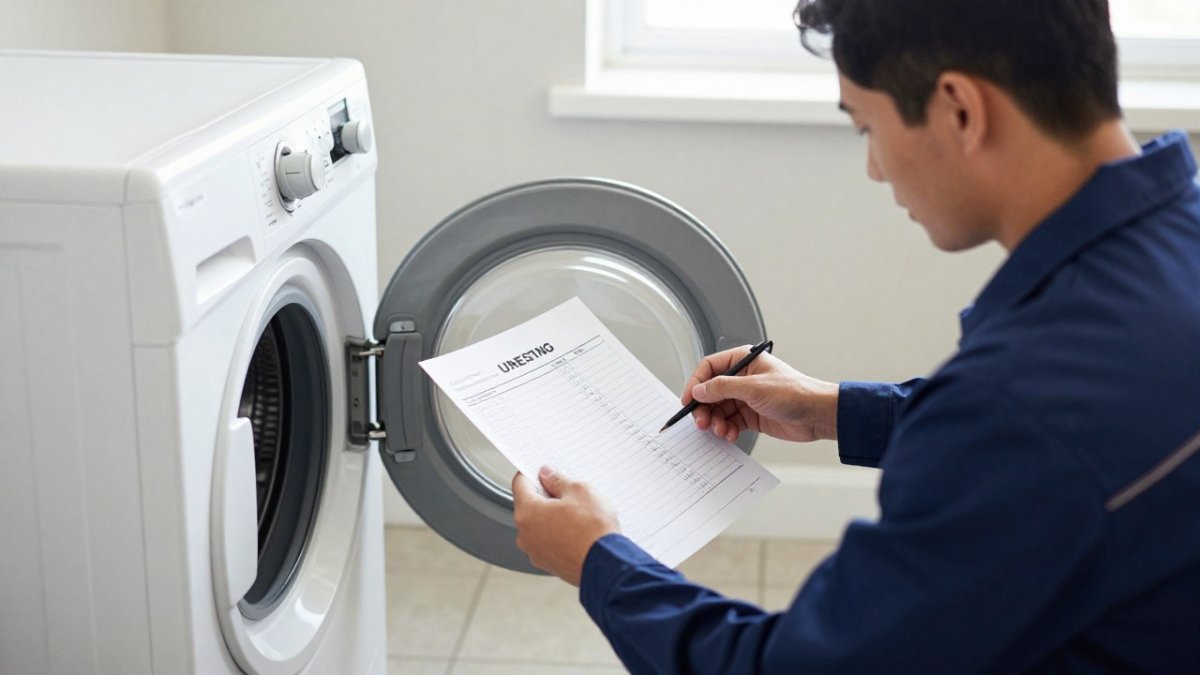
!A technician in a work uniform reviewing a printed checklist beside an open washer on a home laundry room floor
Booking a Verified Technician for Your Next Repair
When you are ready to hire, choose a company that can show you its qualifications up front. At Repair Appliance Pro, our technicians are background-checked, and we offer affordable diagnostic fees. We repair refrigerators, washers, dryers, and dishwashers, so you can get your appliance back in working order without guesswork.
If you want to vet a technician further before you book, read our guide on 7 Ways to Verify an Appliance Technician's Background for a deeper look at each step.
Ready to book? Contact Repair Appliance Pro today.
Frequently Asked Questions
Do appliance repair technicians have to be certified?
Not in every case. Certification is generally voluntary at the national level, and licensing requirements vary by state, . Because rules differ by location, ask any appliance repair technician which credentials they hold and whether they are required to carry a license where they work. A voluntary credential such as NASTeC certification shows tested knowledge of major appliance service, which is a useful signal even when it is not mandatory.
What do you need to become an appliance repair technician?
Most technicians start with a high school diploma or equivalent, then build skills through technical training, an apprenticeship or on-the-job experience. Core skills include understanding electrical systems, working with hand and power tools, using a multimeter and reading wiring diagrams. A clean driving record and reliable transportation are also common expectations for field service work. Use the checklist in this guide to confirm each of these before you hire.
What questions should I ask before hiring an appliance repair technician?
Ask whether the technician is background-checked, what insurance and liability coverage the business carries, and what credentials they hold. Confirm how diagnostic fees are charged and whether they are credited toward the repair if you proceed. Ask which brands they service and whether they have experience with your model type. A reputable provider will answer these questions directly and in writing.