


Last Updated: November 1, 2026
Quick Summary
To verify appliance technician credentials, ask for the exact certification name and issuing organization, then confirm it independently through the organization's own website or phone number. Also confirm identity, insurance, and business legitimacy, and ask which background-check method the company uses. Certification alone proves a passed knowledge test, so treat it as one piece of the puzzle.
- Ask for the full certification name and issuing organization, never a vague claim of being certified.
- Find the organization's contact details yourself instead of using a link the technician texts you.
- A background check should confirm identity, criminal history, employment history, and driving record.
- Ask for two or three recent customers who had the same appliance type repaired, then call them.
- Request a certificate of liability insurance and confirm the policy is active before booking.
Table of Contents
- Why You Should Verify an Appliance Technician Before Booking
- How to Check Appliance Repair Technician Certification
- What an Appliance Repair Technician Background Check Should Cover
- How to Verify Appliance Repair References
- Questions to Ask an Appliance Repair Technician
- Confirming Identity, Insurance, and Business Legitimacy
- Book a Background-Checked Technician with Repair Appliance Pro
- Frequently Asked Questions
Why You Should Verify an Appliance Technician Before Booking
Letting a stranger into your home to work near your refrigerator, washer, or oven is a bigger deal than most homeowners treat it, which is why you should verify appliance technician credentials before booking.
The problem is that "background-checked" gets thrown around loosely in this industry. The only reliable way to know what you're getting is to ask specific questions and confirm the answers yourself.
Verification is not one check. It's a stack of small confirmations that add up to trust.
How to Check Appliance Repair Technician Certification
Start by asking for the technician's certification name and issuing organization. Then confirm it directly with that organization. A real credential can be checked; a vague claim cannot.
Here's the step-by-step process we recommend:
- Ask which certifications the technician holds, by full name, not "I'm certified" but the exact credential title.
- Note the issuing organization and any credential or ID number.
- Look up the organization's official website or phone number yourself, never use a link the technician texts you.
- Contact them and confirm the credential is active, not expired.
- Ask whether the certification covers the appliance type you need fixed.
- Ask when the credential was last renewed and whether it requires continuing education.
- Save a screenshot or PDF of the confirmation for your records.

Recognized Appliance-Repair Credentials to Look For
When a technician names a certification, it should map to one of these categories:
- Industry trade certifications issued by appliance-service trade associations and technician-training organizations. These typically require passing a knowledge exam and renewing every few years.
- Manufacturer factory authorization, the brand itself has trained and approved the technician to perform warranty and out-of-warranty service on its products. This is often the most relevant credential for a specific brand.
- EPA Section 608 certification for technicians who handle refrigerants. This is a federal requirement under the Clean Air Act for anyone servicing sealed refrigeration systems, and it is verifiable through the EPA's certification program.
If a technician cannot name the issuing organization behind a credential, treat the claim as unverified.
How to Verify a Credential With Its Issuing Organization
The verification step is where most homeowners stop short. Here is how to do it properly:
- Find the organization's contact information independently. Search the organization's name and use the phone number or verification portal listed on its own site, not a number the technician provides.
- Ask what the credential covers. A general appliance-repair certification may not cover gas appliances, refrigerants, or high-voltage work. Confirm the scope matches your repair.
- Confirm status and dates. Ask whether the credential is active, when it expires, and whether it has ever been suspended or revoked.
A legitimate certification body will confirm a credential over the phone or through a public lookup tool. If the organization has no way to verify a credential, that itself tells you something about how much weight to give it. Standardized procedures exist to verify technician certification across various specialized fields, ensuring that the professional you hire possesses the necessary technical proficiency for the job.
Certification vs. Licensing vs. Manufacturer Authorization
These three terms get mixed up constantly, and the confusion costs homeowners real money.
- Certification: a credential from an independent organization showing the technician passed a knowledge or skills assessment.
- Licensing: a legal requirement set by a state or local government. Not every state licenses appliance repair, so requirements vary.
- Manufacturer authorization: the appliance brand has approved the technician to perform warranty work on its products.
A technician can hold one, two, or all three. Ask which applies to your brand and model before you book. Manufacturer authorization matters most if your appliance is still under warranty.
What most guides miss is that certification alone doesn't prove someone is safe to have in your home. It proves they passed a knowledge test.
What an Appliance Repair Technician Background Check Should Cover
A real background check goes beyond a name search. It should confirm identity, employment history, and any criminal record that would matter for someone entering your home.
At minimum, ask whether the company checks:
- Government-issued ID and Social Security number match
- Criminal history at the county, state, and federal level
- Sex offender registries
Background checks are not all equal. A quick database search is not the same as a fingerprint-based check through an official channel. Ask which method the company uses.
Consent, Legal Limits, and What Employers Can Actually Check
Background checks for employment in the United States are governed by the Fair Credit Reporting Act (FCRA), which requires the employer to get the applicant's written consent and follow disclosure rules. That's a good sign, not a red flag.
Here's what employers legally can and cannot do:
- They must get written permission before running a check.
- They must follow federal and state rules on what can be reported, including limits on how far back certain records can be reported.
- They cannot run a check secretly or use it to discriminate illegally.
If a company brags about background checks but can't explain its consent process, that's a warning sign. Legitimate employers know the rules.
The Limits of Public-Record Searches
A homeowner can do some verification independently, but it is important to understand what a public-record search can and cannot tell you:
- Court records are public but fragmented. County, state, and federal courts each maintain their own systems, and records may be incomplete, sealed, or expunged.
- Name-based searches produce false matches. Common names generate hits for other people, and without a date of birth or other identifier you cannot confirm a match.
- Arrest records are not convictions. An arrest without a conviction is not proof of wrongdoing, and many states restrict how arrest records can be used.
Do not rely on a single database hit to accuse a technician of anything. If you find a concerning record, ask the company how its screening process handles it, a legitimate employer will have a written policy.
Identity and Employer Verification
Before the visit, confirm that the person arriving is the person the company dispatched:
- Ask the company to send the technician's name and photo in writing before the appointment.
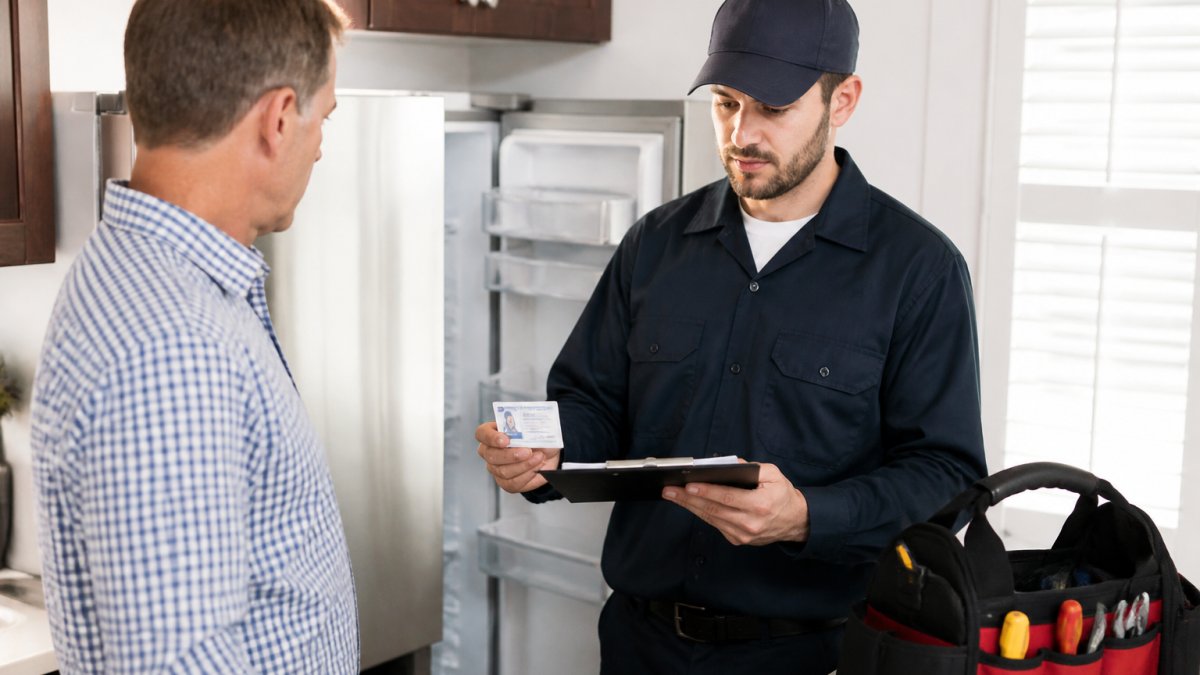
- When the technician arrives, ask to see a government-issued photo ID and match the name to the work order.
- Confirm the company's legal business name against your state's business registry.
- Call the company's published number, not a number on the technician's paperwork, to confirm the dispatch.
These checks are quick, and they catch the most common impersonation and fly-by-night scenarios.
A thorough background check should confirm the following items before a technician enters your home.
| Check | What it confirms |
|---|---|
| Government-issued ID and Social Security number match | Identity |
| Criminal history at county, state, and federal level | Criminal record |
| Sex offender registries | Registry status |
| Employment verification for prior repair work | Work history |
| Driving record, if driving a company vehicle | Driving history |
How to Verify Appliance Repair References
Ask for two or three recent customers who had the same appliance type repaired. Then actually call them.
A short script keeps it simple:
"Hi, I'm considering hiring the technician who repaired your [appliance]. Can you tell me: Did they show up on time? Did the repair hold? Would you hire them again?"
Listen for specifics. "They were fine" tells you little. "My dishwasher has run without a leak for eight months" tells you plenty.
Also check public reviews on Google and the Better Business Bureau. Look for patterns, not single complaints. One bad review happens.
Questions to Ask an Appliance Repair Technician
The right questions separate a professional from a pretender. Ask these before you book:
- Are you employed by the company or a subcontractor?
- Can I see your ID when you arrive?
- What certifications do you hold, and who issues them?
- Are you authorized to work on my brand?
A confident, specific answer builds trust. A defensive or vague one tells you to keep looking.
Confirming Identity, Insurance, and Business Legitimacy
Ask for the company's legal business name and check it against your state's business registry. Confirm the technician's name matches the one dispatched to your home.
Insurance matters too. Ask for a certificate of liability insurance and confirm the policy is active.
Watch out: Some independent technicians carry no insurance at all. If they cause damage, your homeowner's policy may end up covering it, and your premium could rise.
A Pre-Visit Home Safety Checklist
Run through this before the technician arrives:
- Confirm the technician's name and company in writing
- Verify the credential number with the issuing organization
- Ask for proof of insurance
- Clear the work area and secure pets
That last one matters. Ask for the diagnostic fee in writing before you book so there are no surprises.
Book a Background-Checked Technician with Repair Appliance Pro
Verifying a technician takes effort, and most homeowners don't have the time to chase down credentials and insurance certificates. That's exactly where we come in.
At Repair Appliance Pro, our technicians are background-checked. Appliance Services covers professional repair, installation, and maintenance for all major brands. We offer same-day or next-day availability, and you can book online and pay securely.
Ready to skip the guesswork? Contact us now to schedule a vetted technician today.
Frequently Asked Questions
How can I check whether an appliance technician is certified?
Ask for the technician's certification name and credential number, then confirm it directly with the issuing organization. Recognized credentials include NATE and manufacturer-specific training programs, and many certifying bodies offer a public register or phone verification line. A legitimate certified technician will share this information without hesitation. If the company cannot name the certifying body or the number does not match, treat the claim as unverified and ask for a different technician.
What should I ask an appliance repair company before booking?
Ask four things: who will actually arrive at your door, whether that person passed a background check and when, what the diagnostic fee is and whether it is credited toward the repair, and what warranty covers the work. Also confirm the company services your specific appliance brand and model. Get the answers in writing, either by email or in the booking confirmation, so you have a record if the visit goes wrong.
How can I verify an appliance technician's references and experience?
Request two or three references from recent jobs involving the same appliance type you need repaired, such as a refrigerator or front-load washer. Call those customers and ask what failed, whether the fix held, and whether the technician arrived on time and cleaned up. Then cross-check the company's online reviews, reading the ones that name specific appliances rather than generic praise. Reviews that mention your appliance type are the strongest signal of relevant experience.
Does a background check guarantee a technician is safe to let into my home?
No. A background check confirms what is on record at the time it runs, typically criminal history, employment verification, and identity confirmation. It does not predict future behavior or capture incidents that were never reported. Use it as one layer alongside credential verification, reference calls, and your own judgment at the door. Ask the company when the check was last run, since a check from five years ago says little about the person arriving today.
The difference between a safe repair and a risky one often comes down to a few questions asked upfront. Repair Appliance Pro removes that burden by staffing only background-checked technicians, quoting diagnostic fees clearly, and offering same-day or next-day service for refrigerators, washers, dryers, dishwashers, and ovens. Get started with Repair Appliance Pro and book a technician you can trust in your home.